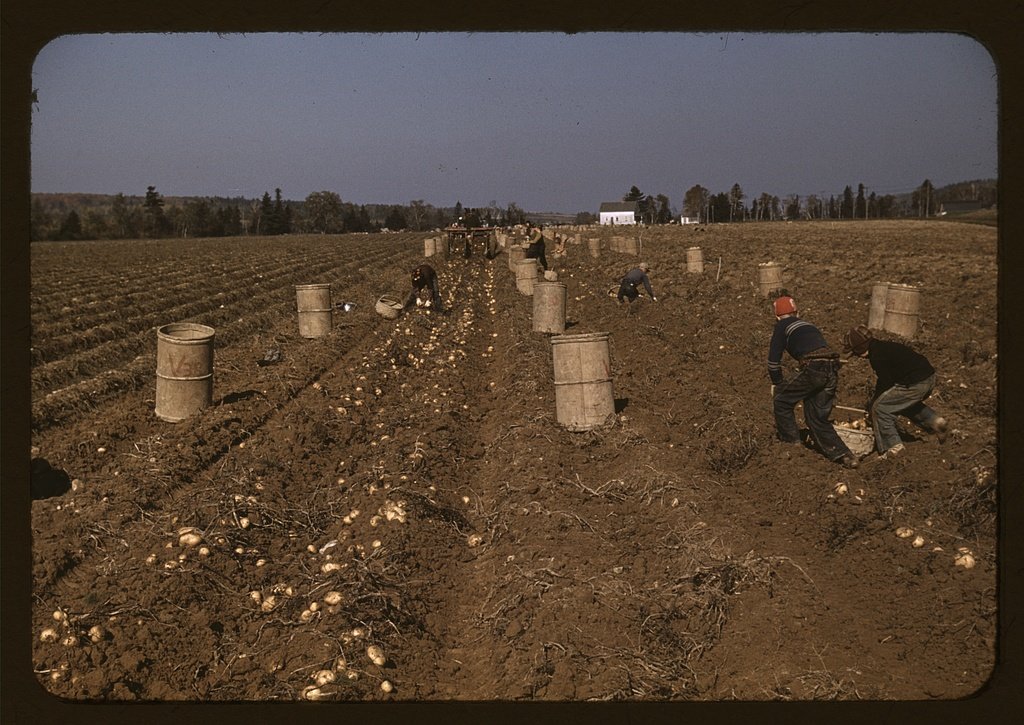
Here's a calendar quirk that surprises people who didn't grow up in farm country: in some places, school schedules bent around the harvest. When the crop was ready, the crop came first — and classrooms waited.
In potato country, that meant a break in the fall so families could get the harvest in before the ground froze. Kids helped pick, older students worked alongside grownups, and the whole community moved to the rhythm of the fields for a few weeks. Then everyone went back to their desks, a little tired, a little richer, and with dirt still under their fingernails.
A photograph from the field
The image with this piece is by Jack Delano, one of the photographers who documented American life for the Farm Security Administration. It's held by the Library of Congress, and its caption notes that schools wait on potatoes. We don't know the names of the people in the frame, and we won't make them up — but the scene speaks for itself: open fields, hard work, and a community where everyone pitched in.
Delano's photographs are a gift to anyone who loves this era. He had a way of showing ordinary work with real dignity — not posed, not polished, just people doing what needed to be done.
Why it mattered
For farm families, harvest time wasn't optional. A crop left in the field was income lost, and many hands made the work go faster. Letting school pause was a practical answer that a lot of towns understood. It also built something harder to measure: kids learned what work felt like, what a full day meant, and how much a neighbor's help was worth.
The things people remember
Ask anyone who grew up around a harvest and the details come quickly — the early mornings, the cold hands, the baskets or barrels, the lunch that tasted better than any lunch ever should, and the pride of a paycheck or a parent's nod at the end of the week. Even folks who grew up in town often remember a version of it: berry picking, corn detasseling, helping a relative with hay, or a fall break that everyone knew was really about the farms.
Different calendars, same lessons
School calendars look different in most places now, and the machines do much more of the work. But the idea behind that potato break — that a community rearranges itself to take care of what matters — still feels worth remembering.
Your turn
Did your school ever close or bend for a harvest? Did you pick, haul, or pack anything as a kid? Come tell us about it on the Front Porch. We'd love to hear it.